


Art Problems in Hyperallergic: How Do I Get Into the Whitney Biennial?
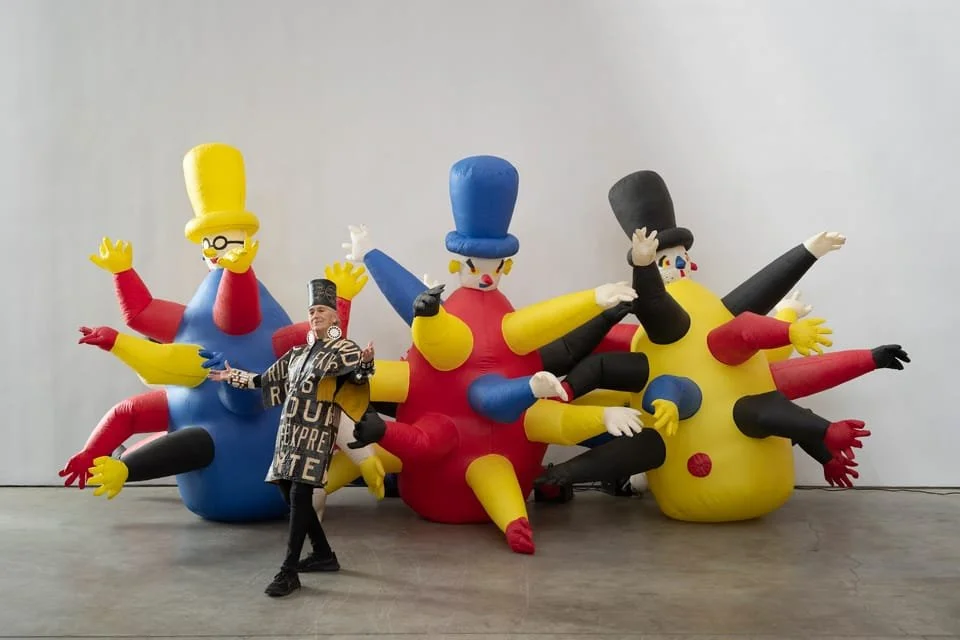
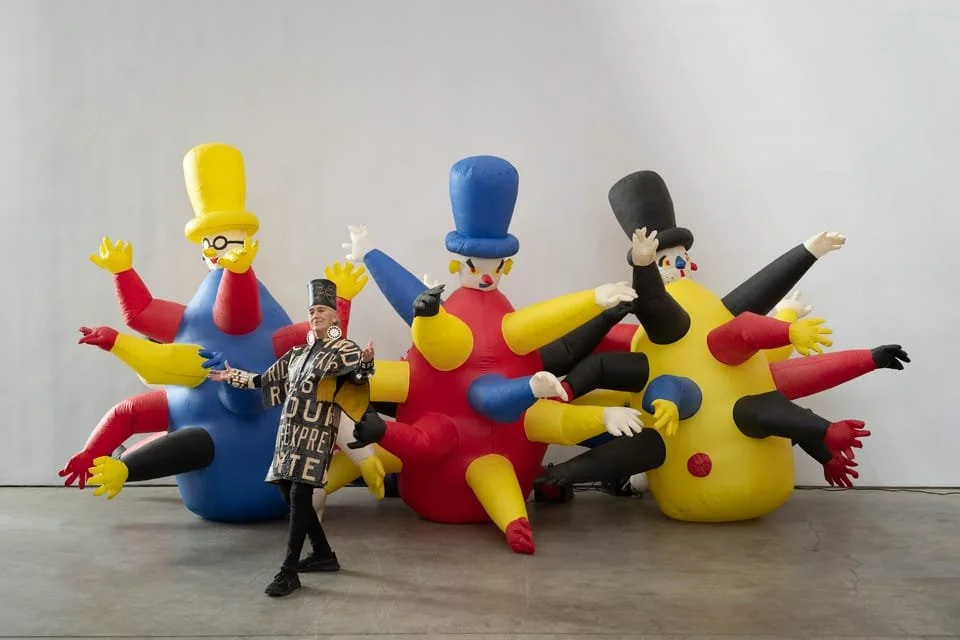
Pat Oleszko with "The Trojan Horse" (1987), nylon and blower, in her forthcoming exhibition at SculptureCenter in Queens (photo by Charles Benton, courtesy the artist; SculptureCenter, New York; and David Peter Francis, New York)
In my latest Art Problems column for Hyperallergic, I write about how artists can get selected for the Whitney Biennial.
I’d love to be considered for the Whitney Biennial, but getting into it — even better! How does an artist get these curators into their studio? What can I expect after that? Can I do anything to improve my chances? —Longing for the Whitney
Many artists have these questions, but few share them with me. Conventional wisdom has such sway: Make good work. Hang out with the right people. Be charming in the studio and wait for your call from the curators.
In short, conventional wisdom says there isn’t much you can do beyond spending time in your studio and employing shrewd social calculation. While there’s a grain of truth in that, it’s not the whole story.
Before getting into what you can do, ask what the biennial means to you and how that aligns with your career. Do you want to participate because it is the most recognized exhibition in the United States? Most artists would concede that’s part of it.
When I spoke with performance artist and 2026 Whitney Biennial participant Pat Oleszko, she described the event as one everyone knew of, even if they weren’t in the art world. To illustrate this, she described protestors at the No Kings rally in New York earlier this month who learned that the costumes she and her friends were wearing were made by a Whitney Biennial artist. She recalled, “I watched the wave of biennial recognition flow down the street” as people said, “Oh, she’s a biennial artist!”
Many assume inclusion is an endorsement of the work’s quality, which can further an artist’s career. But your art needs to speak to the biennial curators and align with cultural interests. Often, the work selected has a kind of buzz around it that is impossible to engineer.
To read the full piece, complete with practical tips and strategies, head to Hyperallergic.
Netvvrk 2025 Report on Artist Careers Featured in Hyperallergic
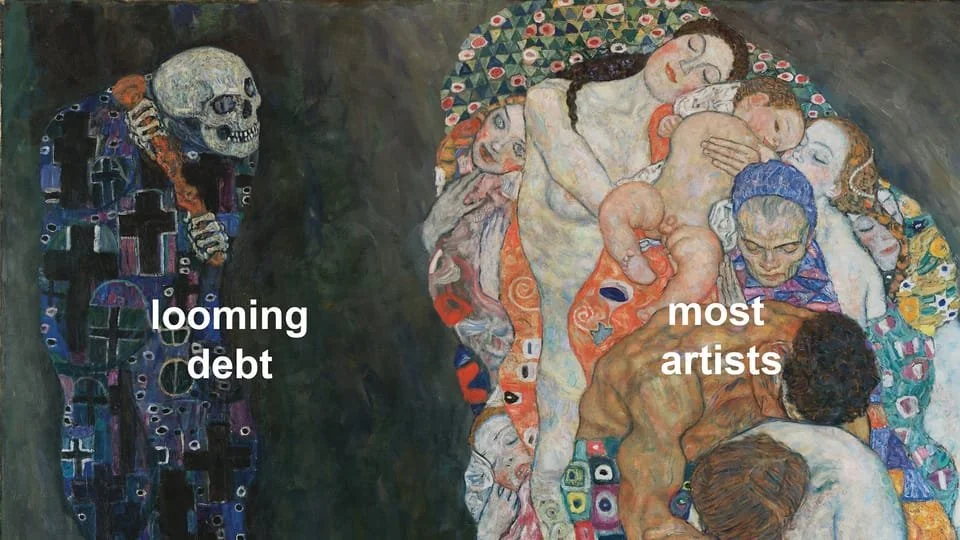
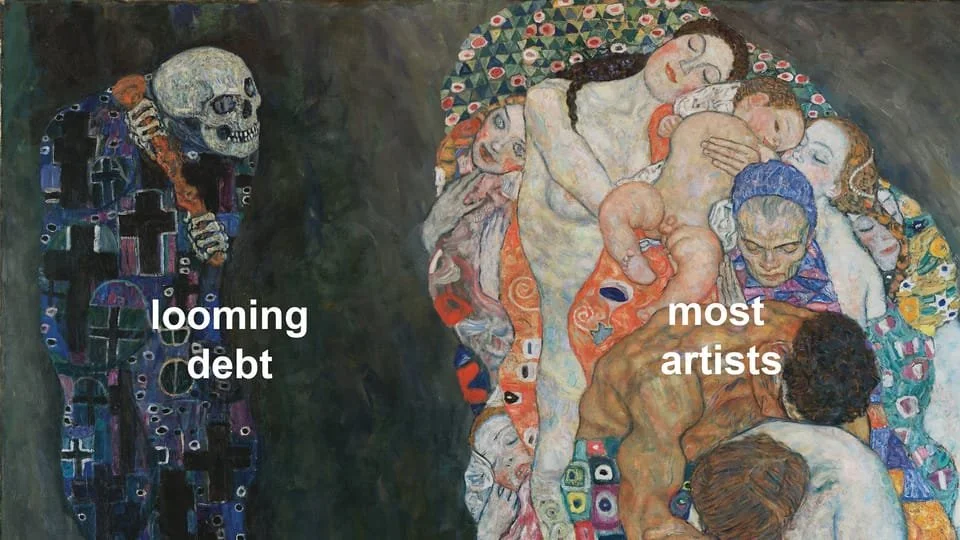
In the survey, 45% of artists reported that they earned less from their practice in 2025 than they did last year. (image of Gustav Klimt's "Death and Life" (1915) via Wikimedia Commons, CC0 BY 4.0; edit Lakshmi Rivera Amin/Hyperallergic)
Rhea Nayyer details the findings of the Netvvrk New Visions survey on artist careers for Hyperallergic. In it she writes,
Findings from a new survey for artists report that 56% of participants are working through debt. That statistic climbed to 59% for those with gallery representation and museum shows under their belt. According to art critic and career advisor Paddy Johnson, who spearheaded the "New Visions" survey, data compiled from over 1,000 respondents indicates that “artists across all levels struggle with a lot of the same things.”
Johnson — who also pens Hyperallergic's advice column Art Problems — said in a phone interview that “the part of the industry that I surveyed tends to be underrepresented,” noting that a majority of market reports specifically focus on mainstream, commercially successful artists and artworks, as well as high-profile fairs and auctions. Per the “New Visions” survey findings, 75% of participants make less than $15,000 annually through their practices, with more than half making $5,000 or less per year. Those figures have done little to sully respondents' creative motivation, though, since 73% “remain optimistic about their careers.”
Netvvrk’s New Visions Report Featured in ARTnews
Image: E. Brady Robinson
Brian Boucher at ARTnews shares the highlights from the New Visions Report. Boucher introduces the survey and establishes its importance to the field. He writes,
The art world may not be the most data-informed industry, but there are regular reports on the art market, such as the UBS Art Basel Market Report, which surveys auction houses, galleries, and fairs; UBS collector surveys; and the Artnet Intelligence Report, which analyzes that company’s proprietary auction data. If you noticed that artists don’t seem to appear in those reports, well, New York artist mentor Paddy Johnson is one step ahead of you. Her inaugural New Visions Report, released Wednesday, surveyed 1,000 mid-career creators with the aim of assessing their careers the same way other businesses are evaluated.
Boucher goes on to report on several of the more significant findings in the report.
The majority of these artists rely on other income, with 57 percent holding down a full-time or part-time day job. The market contraction has hit artists pretty hard, with 45 percent earning less in 2025 than they did in 2024, even though 64 percent kept their prices flat, suggesting that they, not their collectors, are taking the hit of the market contraction and rising inflation.
Yet for all of these problems, there are some highlights, pulled out the survey’s business analyst, Tim Schneider, and used to close out the article.
Artists remain hopeful all the same, with some 73 percent of respondents ranking their career prospects 3 or higher on a scale of 0 to 5. Many are taking action on that hopeful attitude, with 86 percent setting professional goals, 79 percent socking away money in savings accounts, retirement funds, and/or emergency funds.
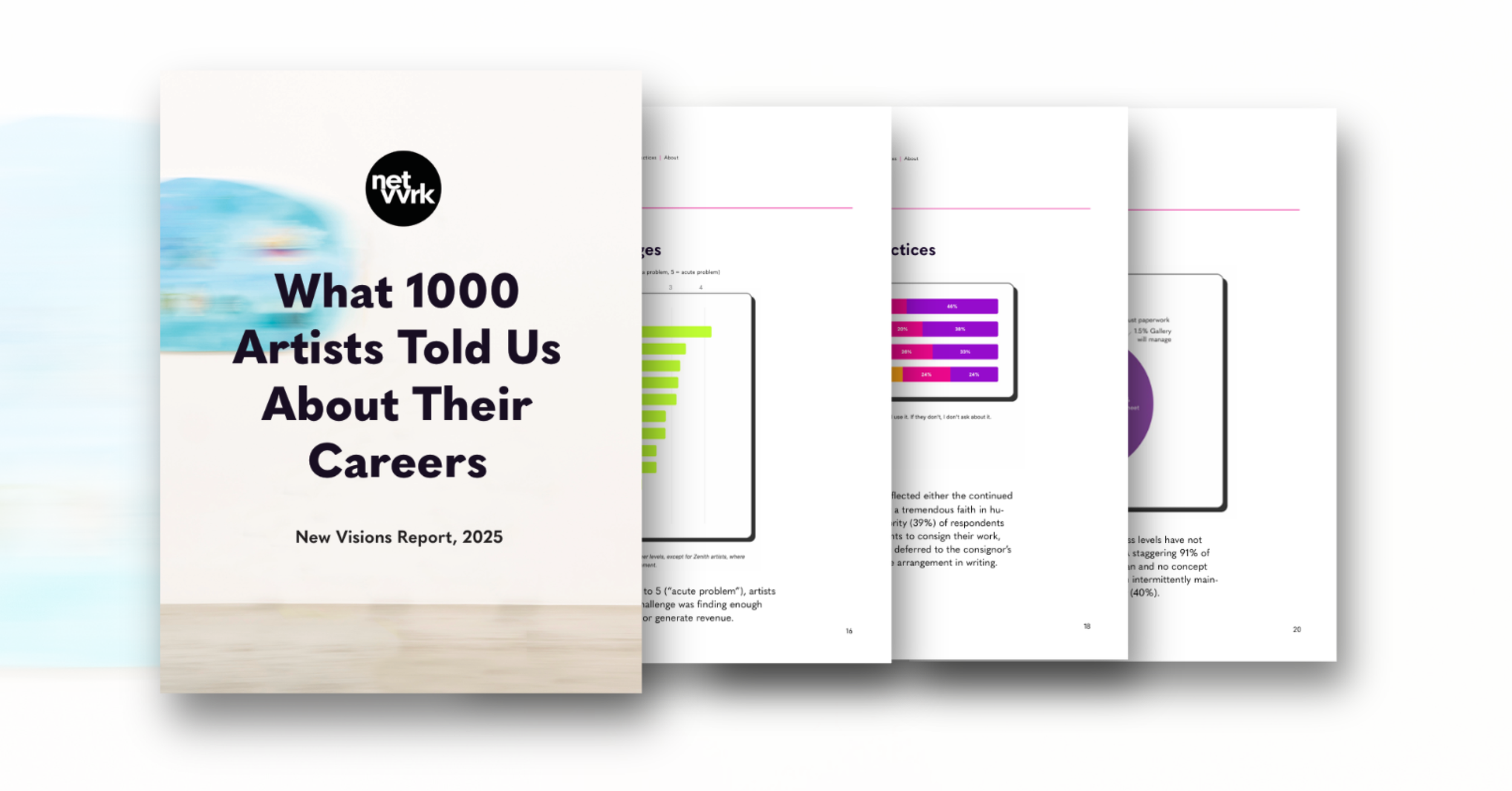
What 1000 Artists Told Us About the Their Careers: The New Visions Report, 2025
The New Visions Report has arrived. It represents one year of research, 1000 artists, and the clearest picture yet of what it takes to build an art career in 2025.
This report synthesizes the results of two surveys sent out over the course of 2025, with data analysis by Tim Schneider and reflection by Netvvrk founder, Paddy Johnson.
What emerges is a portrait of an industry that relies heavily on artists who self-subsidize their careers. Without the professional support other businesses take for granted—accountants, estate planning, HR departments—artists improvise, adapt, and somehow survive.
Whether you're an artist, curator, dealer, or other arts professional, the findings and the best practices detailed in this report will be valuable to you.
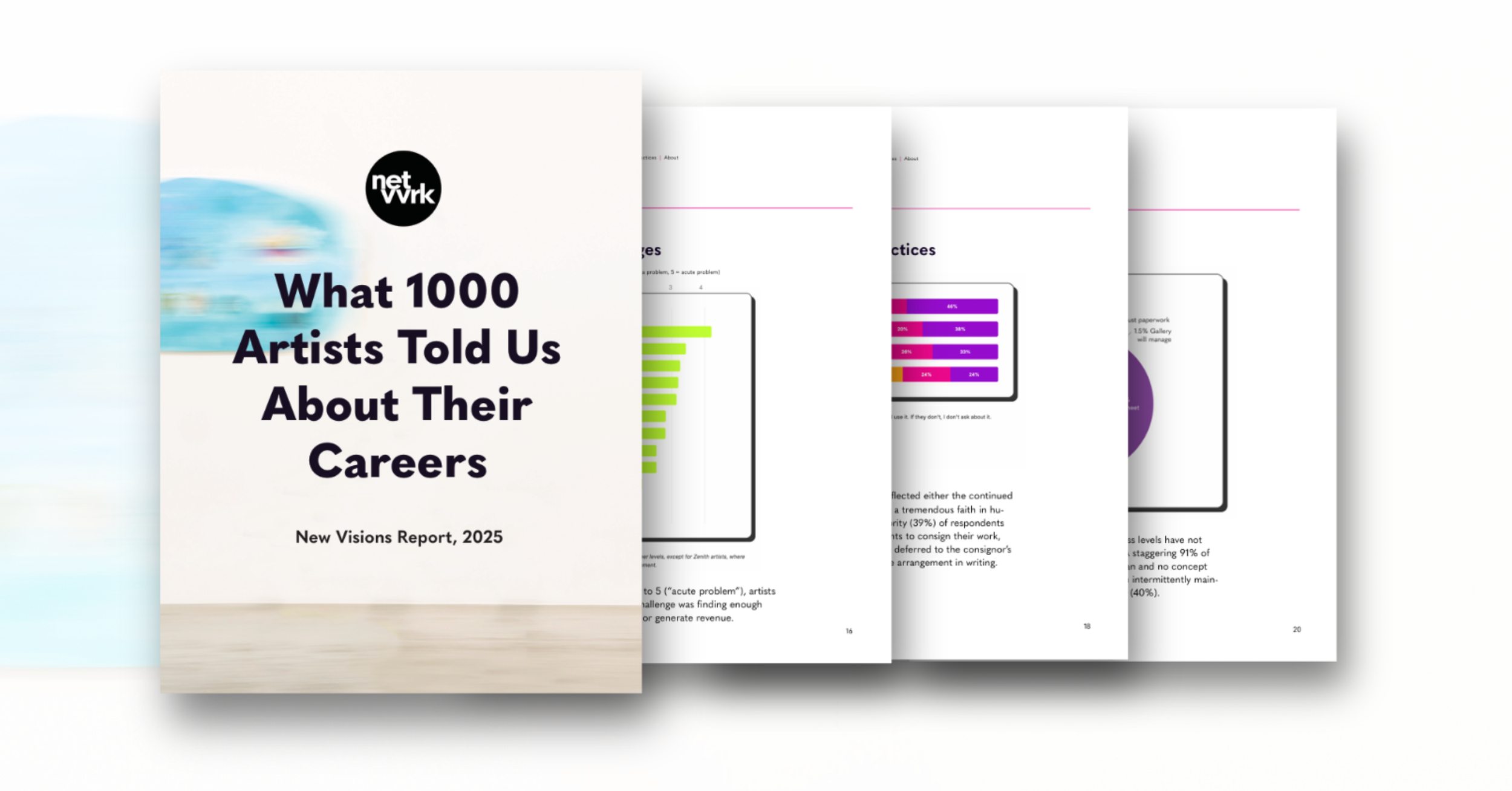
The New Visions Report has arrived. It represents one year of research, 1000 artists, and the clearest picture yet of what it takes to build an art career in 2025.
This report synthesizes the results of two surveys sent out over the course of 2025, with data analysis by Tim Schneider and reflection by Netvvrk founder, Paddy Johnson.
What emerges is a portrait of an industry that relies heavily on artists who self-subsidize their careers. Without the professional support other businesses take for granted—accountants, estate planning, HR departments—artists improvise, adapt, and somehow survive.
Whether you're an artist, curator, dealer, or other arts professional, the findings and the best practices detailed in this report will be valuable to you.
Art Problems in Hyperallergic: Am I Too Old?
In art as in life, age is just a number. (edit Shari Flores/Hyperallergic)
Over at Hyperallergic I take on the questions of agism, sexism, and class for artists in my latest Art Problems column, Am I too Old?
As the title promises I address questions like, are you too old to make it? Do you need hipper connections? Do you need wealth to connect to wealth? And of course, on the wealth question, do you even care about such things?
The TLDR (too long didn't read) of it, goes something like this:
You're never too old.
The end.
But you knew that. The question is how to deal with agism in the art world, which is a real issue regardless of how old you feel.
In this article I share practical advice, mindset strategies, and a real life anecdotes relating to how I ended up surrounded by models in the home of a wealthy of diamond dealer.
Have a read, and let me know what you think by tagging me on Instagram.
Netvvrk featured in the New York Times!

It’s a big day for us here at VVrkshop!
Netvvrk, our flagship membership program has been featured in an article by Travis Diehl in the New York Times (paywall). The piece explores the world of online artist mentoring and how Netvvrk fits into it. A small clip from a much larger piece:
“What we are trying to do is to make things easier for artists and also to set expectations appropriately,” Johnson said. Sure, members start out wanting to know how to get more shows and find galleries, she continued, but “those questions get answered naturally” as you focus on meeting people and making art.
Johnson has several part-time employees, including William Powhida, a New York artist known for critiquing art’s power structures in his drawings and writing. In his view, the group can help people “understand what the field looks like and how rare it is to achieve the kind of art world success that they might be seeing or reading about.”
Read the piece and let me know what you think. As always, I want to hear from you!
Game on For Artists: My Interview on Art Spiel

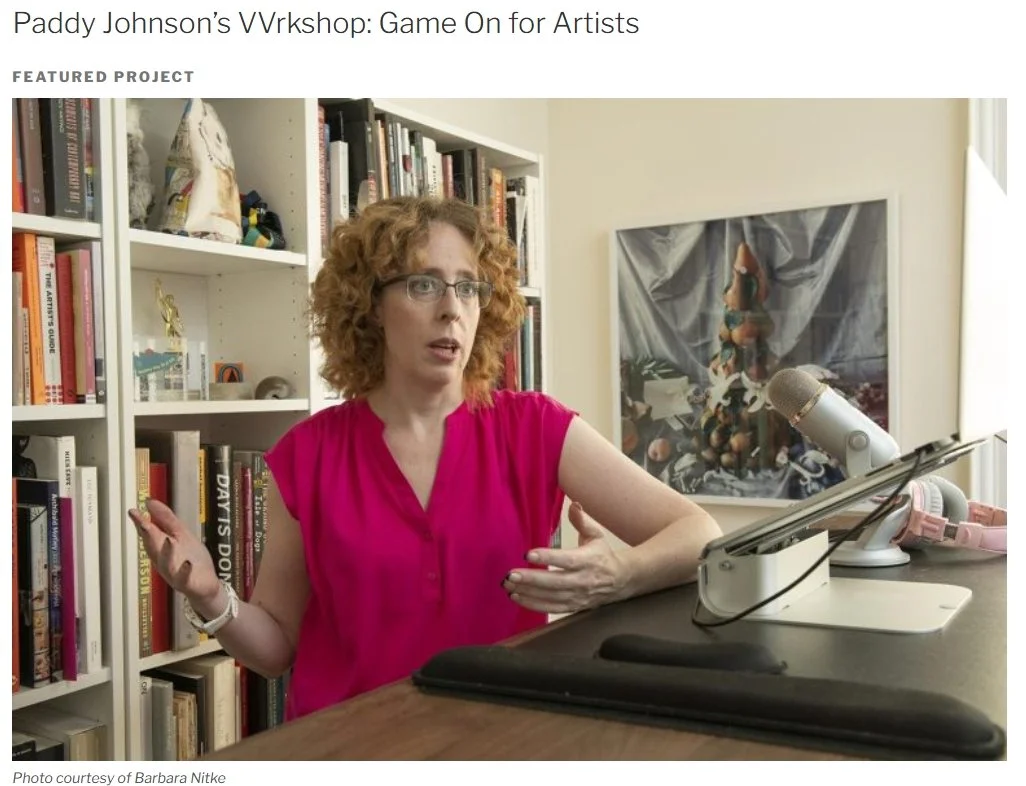
What can be done to place more power in artist's hands?
Broadly speaking: name the problems facing artists and build systems to overcome them.
In a wide-reaching conversation with Etty Yaniv at Art Spiel, we discuss Imposter syndrome, MFAs, MBAs, turning 50, and how Netvvrk helps artists get the visibility they deserve.
To help you dig your teeth into this discussion, I want to start you with this excerpt on what's to come in my 2025. May you find power in experience.
For men, 50 represents a major milestone – a symbol of the knowledge and power accumulated over those years. For women, the number can evoke a sense of loss. We are past the childbearing stage and thus past our prime.
Well, that’s just bullshit and I refuse to play into a cultural narrative that doesn’t acknowledge my wisdom and my power.
What if we viewed 50 for what it really is – a new beginning, an awakening, a milestone that tells us the best is yet to come?
I don’t want this question to be hypothetical. I’m treating my 50th as a time for celebration. I have a lot more to do in this life and it took me this long to get the skills I need to achieve it. I’m excited about this new phase and I hope that other women will feel as energized as me when they hit it too.
Read the whole discussion here.
And please share it on Instagram or your social network of choice if you find the conversation valuable!
Art Problems in Hyperallergic: Those Artworks Aren't Gonna Sell Themselves

Artist are sometimes their worst enemies (edit Sigourney Schultz and Shari Flores/Hyperallergic)
This week in Hyperallergic, I ask dealers, curators, and organizers to give me tips on how artists can collaborate better. I collected a lot of advice you might be surprised by, but I also break down some of the contradictions that make this world so difficult to navigate.
Take a look:
Both dealers Daniel Kinkade and Phillip Niemeyer, the founder of Austin-based gallery Northern Southern, cited the importance of pricing consistency. “Understand that a 50% split is normal for all retail, not just art,” Niemeyer told me. He listed out other bits of advice: “Don’t be desperate, don’t fire-sale your work on Instagram unless you are done making art, and don’t sell out of your studio if you have a gallerist.” (“Fire-selling” refers to selling work at an extremely discounted price).
Of course, there are exceptions to all of these cases, which is what makes the business so challenging.
Being desperate usually translates into spamming and harassing your dealer, but artists may also be forced to send multiple emails if the dealer is uncommunicative. You shouldn’t fire-sale your work, but you can fire-sale a bunch of old drawings with little resale value to make room in a flat file. You shouldn’t sell out of your studio if you have a gallerist, but many artists have galleries halfway across the country that never sell to local collectors.
To read the full article, click here.